How often do matches end a draw when it’s 0-0 at half-time?
In this analysis, I delve into second-half data based on commonly occurring half-time scores. To conduct this study, I sourced data from footystats.org, using eleven seasons of data ranging from 2011-2022. To analyse the data, I utilized R and Excel.
To ensure a comprehensive analysis, I selected a sample size that encompasses 20,084 football matches spread over eleven seasons. The dataset I used includes the top five leagues in Europe: the English Premier League, Italian Serie A, French Ligue 1, Spanish La Liga, and the German Bundesliga.
A quick insight.
At the start of the World Cup in Qatar, there were several complaints about goalless draws during the first round of the group stage. Several nations approached their matches conservatively, aiming not to lose their first games.
However, as the first round progressed, teams became more adventurous, leading to fewer 0-0 draws. While watching some of the games, I was concerned that I might witness another boring match without any goals, particularly when the teams were level at half-time. Nonetheless, my worries were unfounded, as many goals were scored early on in the second half, making the tournament more exciting.
This sparked my curiosity. How often do goalless draws actually happen? I surmised that they may occur more frequently in tournament football due to the higher stakes involved. As a result, I decided to investigate this question in league football.
A glimpse at the data.
I began by examining the English Premier League (EPL) statistics. The dataset contained 4,180 matches, out of which only 306 ended in a 0-0 draw (7.3%). Given that the average goals scored per game in the EPL is 2.74, it’s not surprising that the number of full-time 0-0 score lines is relatively low. This trend is also seen across the top five leagues, where there is a higher volume of goals scored due to the presence of top-level finishers.
| League | Matches | FT 0-0 | % of FT 0-0’s | Average Goals |
|---|---|---|---|---|
| German Bundesliga | 3364 | 210 | 6.2% | 2.98 |
| Italian Serie A | 4180 | 305 | 7.2% | 2.77 |
| English Premier League | 4180 | 306 | 7.3% | 2.74 |
| Spanish La Liga | 4180 | 334 | 7.9% | 2.68 |
| French Ligue 1 | 4180 | 414 | 9.9% | 2.53 |
In contrast to the other four top European leagues, France’s Ligue 1 has a significantly higher proportion of goalless matches, with almost one in ten matches ending 0-0. This is in spite of the fact that the German Bundesliga, which has the highest average goals per game among the top leagues, has less than half the proportion of goalless matches compared to Ligue 1.
When is the first goal typically scored in the second half if the score is 0-0 at half-time? (if there is a goal)
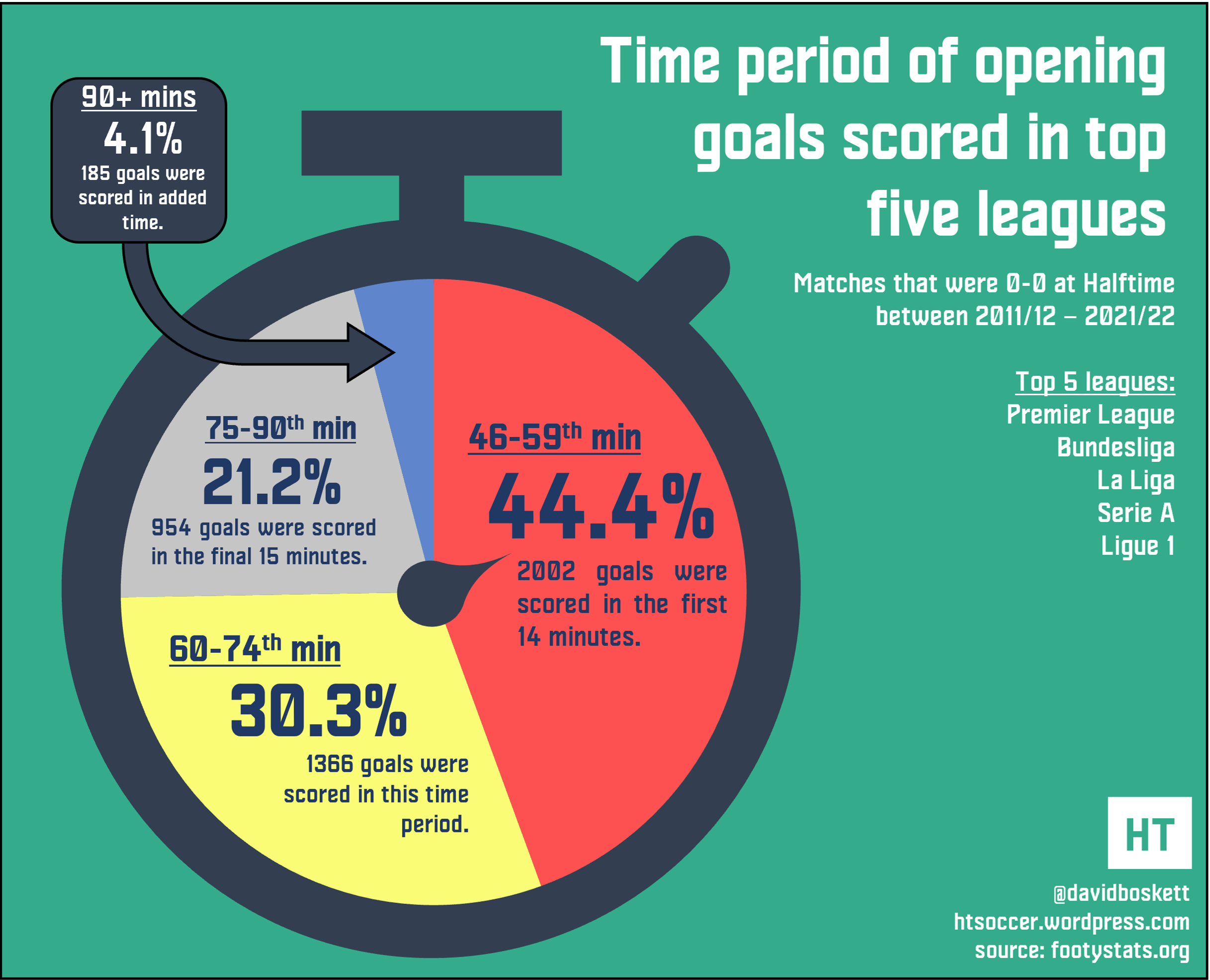
If we focus on games where the first goal is scored in the second half, what is the most common minute for that goal to be scored? Surprisingly, the average minute for the opening goal in these matches is the 64th minute. This timing is consistent across all five leagues, with a range of only one minute, from the 63rd to the 65th minute. Additionally, the timing of goals scored in the second half is similar across the top five leagues, with most goals being scored between the 46th and 74th minute.
Looking into the probabilities.
It is uncommon for any opening goals to be scored after the 90th minute. If you are watching a football match where the score is 0-0 and it is about to enter injury time, the likelihood of witnessing the first goal of the match is approximately 31/1. However, there is a 55% chance that you will see the first goal of the game before the 75th minute. But between the 75th and 90th minute, the probability drops to heavily down to 22%.
NOTE: Try not to confuse this probability with the above data visualisation which only measures what time goals are scored in matches where they are scored.
Average goals scored in the second half when 0-0 at half-time.
| League | 0-0 HT Matches | Average second half goals |
|---|---|---|
| German Bundesliga | 867 | 1.5 |
| Italian Serie A | 1,257 | 1.4 |
| English Premier League | 1,242 | 1.4 |
| Spanish La Liga | 1,318 | 1.4 |
| French Ligue 1 | 1,394 | 1.3 |
France’s Ligue 1 noticeably features more goalless matches than the other four (one in ten matches are 0-0), almost doubling the amount found in the German Bundesliga which features more goals on average than any other league.
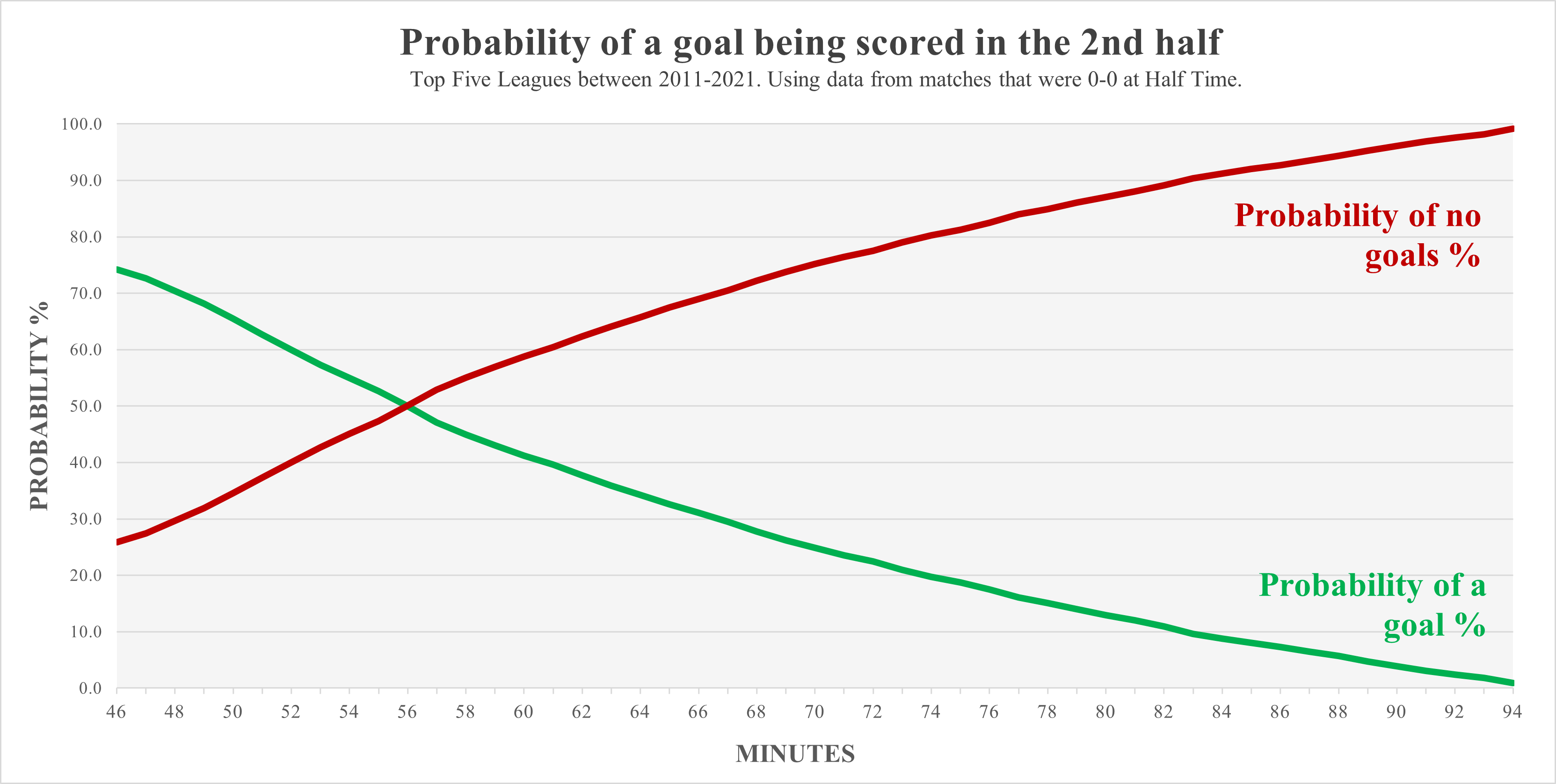
Based on the second half data analysis that shows an average of around 1.4 goals per match, it is reasonable to assume that in any of the top five leagues, if the scoreline is 0-0 at half-time, there is a high probability that at least one goal will be scored in the remainder of the match. Out of a total of 6,078 matches where the score was 0-0 at half-time, only 1,569 matches ended in a goalless draw at full time (26%). Therefore, the probability of a goal being scored at the start of the second half is 74%.
The likelihood of a goal decreases as time decays.
Consider if you were to fast forward to the 60th minute mark, the probability of seeing a goal drops dramatically to 41%, even though the average first goal is scored in the 64th minute. If you skip ahead again to the 75th minute, the chance of a goal being scored is only 19%. At this stage, it’s highly probable that the match will end 0-0.
The rapid drop in probability during the first fifteen minutes of the second half suggests that the majority of goals are scored between the 46th and 60th minute mark. This trend may be attributed to teams returning from the halftime break energized and motivated to score.
Most common full time scores when it is 0-0 at half-time (top five leagues)
| League | 1st most common | 2nd most common | 3rd most common | 4th most common |
|---|---|---|---|---|
| Premier League | 1-0 (33%) | 0-0 (25%) | 2-0 (13%) | 1-1 (10%) |
| La Liga | 1-0 (34%) | 0-0 (25%) | 2-0 (13%) | 1-1 (11%) |
| Serie A | 1-0 (31%) | 0-0 (24%) | 2-0 (14%) | 1-1 / 2-1 (11%) |
| Bundesliga | 1-0 (28%) | 0-0 (24%) | 2-0 (17%) | 1-1 (12%) |
| Ligue 1 | 1-0 (31%) | 0-0 (30%) | 2-0 (12%) | 1-1 (11%) |
The consistency of the most common full time scores across all top five leagues is truly remarkable, with the same scores appearing in the same order. The only variation is found in Serie A, where a 2-1 score line is equally as common as a 1-1 result.
One noticeable difference in terms of percentages is seen in Ligue 1, where 30% of matches ended in a 0-0 score line, which is around 5-6% higher than the other leagues. Another noticeable trend is the significant drop in the frequency of occurrences between the 0-0 and 2-0 score lines. While the first and second most common scores are similar across all leagues, there is a considerable gap when it comes to the third most common score line, which continues to widen across each league.
Now to make this even more interesting, let’s see the difference when we look at the most common full time scores when it’s 1-1 at half-time:
| League | 1st most common | 2nd most common | 3rd most common | 4th most common |
|---|---|---|---|---|
| Premier League | 2-1 (33%) | 1-1 (21%) | 3-1 (14%) | 2-2 (13%) |
| La Liga | 2-1 (31%) | 1-1 (22%) | 2-2 (15%) | 3-1 (13%) |
| Serie A | 2-1 (31%) | 1-1 (24%) | 3-1 (15%) | 2-2 (11%) |
| Bundesliga | 2-1 (30%) | 1-1 (24%) | 3-1 (14%) | 2-2 (12%) |
| Ligue 1 | 2-1 (35%) | 1-1 (24%) | 3-1 (14%) | 2-2 (10%) |
Does a home advantage really exist in these scenarios?
Among the five selected leagues, Ligue 1 in France stands out with the highest probability of a draw in 0-0 half-time matches at 44%. However, when the score is 1-1 at half-time, the draw probability drops to 37%, indicating that a home win is equally likely as a draw (36%).
This is not the case in the other four leagues, where the probability of a draw is always equal to or just slightly higher than the probability of a home win, usually differing by only 1-2%. In all of these leagues, the away team tends to struggle in these matches, with a win rate ranging between 22-27%.
| League | HT 0-0 Home Win | HT 0-0 Draw | HT 0-0 Away Win | HT 1-1 Home Win | HT 1-1 Draw | HT 1-1 Away Win |
|---|---|---|---|---|---|---|
| Premier League | 37% | 36% | 27% | 34% | 35% | 29% |
| La Liga | 37% | 37% | 26% | 40% | 38% | 22% |
| Serie A | 36% | 37% | 27% | 36% | 37% | 27% |
| Bundesliga | 37% | 37% | 25% | 36% | 38% | 27% |
| Ligue 1 | 37% | 44% | 23% | 36% | 37% | 25% |
At 1-1 HT, the home team still maintains a slightly higher chance of winning. This suggests that scoring in the first half doesn’t necessarily give the away team a significant advantage, and the home team still retains their advantage in familiar surroundings with their home crowd behind them.
Based on the data presented, a home advantage does seem to exist in these scenarios. The away side rarely wins in matches with 0-0 or 1-1 halftime score lines across the five top European leagues. However, it’s important to note that a draw is as likely than a home win in these scenarios, so it’s not a sure-fire bet.
If you were to bet on a match where it is 0-0 at half-time, here are the true odds based on using this historical data set (all five leagues):
Home Win: 2.74 (7/4) Draw: 2.64 (13/8) Away Win: 3.92 (3/1)
End of analysis.
I thoroughly enjoyed analyzing this project as it has provided me with valuable insights into how soccer matches tend to unfold, both presently and in the future. Having recently watched a few matches that were 0-0 at half-time, I was intrigued by the possibility of witnessing an opening goal in the first 25 minutes of the second half. It was fascinating to observe that this prediction was often accurate, as the data showed that many goals tend to occur within this time frame.
In fact, during the most recent game I watched before publishing this article – Chelsea vs Manchester City – Riyad Mahrez scored in the 63rd minute, one minute before the Premier League’s average for opening goals in the second half. This goal was particularly satisfying as it reinforced my findings that the first 25 minutes of the second half is when most goals occur.
Speaking of Manchester City, my analysis revealed that they have the highest points per game when the match is 0-0 at half-time between 2011-2022. Out of 101 matches that were 0-0 at half-time, they won an impressive 61, drew 28, and lost only 12.
| Pos. | Team | PLD | W | D | L | P | PPG |
|---|---|---|---|---|---|---|---|
| 1. | Man. City | 101 | 61 | 28 | 12 | 211 | 2.09 |
| 2. | Arsenal | 114 | 58 | 34 | 24 | 208 | 1.82 |
| 3. | Tottenham | 112 | 51 | 34 | 27 | 187 | 1.67 |
| 4. | Liverpool | 101 | 40 | 40 | 21 | 160 | 1.58 |
| 5. | Chelsea | 122 | 48 | 47 | 47 | 199 | 1.56 |
| 6. | Man. Utd | 113 | 45 | 41 | 27 | 176 | 1.56 |
Before I end this article I will finish by answering the very first question I asked, which was:
How often do matches end a draw when it’s 0-0 at half-time?
Answer: Out of the 6,077 matches played in the top five leagues between 2011-2022 that were 0-0 at half-time, 2,302 ended in a draw. This means that 38% of matches ended in a draw when the score was 0-0 at half-time, which is slightly higher than expected but still less than half of the matches. This means that just under 4 out of every 10 matches end in a draw when the score is 0-0 at half-time.

 OddsDash
Leave a comment